ANSWER ECONOMY TRACKER / TRAVEL 01
Method, sample and limitations
Prepared 10 October 2026. Fixed data cutoff: 28 September 2026. This is a descriptive analysis of captured answer text. It is not a study of actual travellers, commercial outcomes or consumer-app behaviour.
1. Questions, dates and collection
We use 20 fixed, unbranded, authored travel questions with the UK configured as the collection market. The same exact question strings occur in every included run file. One stored answer per engine and question is used in each included run; these are repeated observations, not 742 independent questions or people.
Google AI Overviews and AI Mode were captured through a search-results service (SerpAPI). The other four labels refer to API collections: OpenAI (labelled ChatGPT in the tracker), Anthropic Claude, Google Gemini and Perplexity. API answers need not match consumer apps, logged-in accounts, personalisation or real travellers’ locations.
The nine included captures are dated 3, 16, 17, 24 and 31 August and 7, 14, 21 and 28 September 2026. Captures are roughly weekly rather than exactly seven days apart. The series starts on 3 August, the first capture for which the original Google responses were stored; the other engines' included windows also start in August.
| Engine label | Included dates | Usable / included slots |
|---|---|---|
| AI Overviews | 3 Aug to 28 Sep | 168 / 180 |
| AI Mode | 3 Aug to 28 Sep | 179 / 180 |
| Claude | 16 Aug to 28 Sep | 146 / 160 |
| Gemini | 16 Aug to 28 Sep | 149 / 160 |
| ChatGPT (API) | 3 Aug, 21 & 28 Sep | 60 / 60 |
| Perplexity | 21 & 28 Sep | 40 / 40 |
2. Eligibility
There are 780 answer slots in the selected engine windows; 742 qualify. We exclude 21 missing or shorter-than-50-character responses, then 16 responses failing completion checks, then 1 Google AI Mode response that was a service notice (“You’ve reached the request limit for AI responses”) rather than an answer. Exclusion categories do not overlap. A usable answer with no matched name remains in the corpus.
Eligibility checks capture availability and completion, not answer relevance or recommendation quality. Two AI Overview outputs, on 24 August and 14 September, defined the word “best” instead of answering the travel question. We retained these as observed answer-block output with no matched names. Service notices were excluded because no answer was produced. Excluding the two definitions as well would leave 740 answers and move the AI Overviews repeat overlap from 48.0% across 117 pairs to 49.7% across 113; the six-engine snapshots, the other engines and the published 47% to 55% range are unchanged.
For non-Google-surface collections we inspect the referenced raw provider record. Claude requires end_turn; Gemini requires STOP; OpenAI requires completed with no incomplete details. Perplexity uses its service-specific completion signal: stop for the earlier response format, or completed with no incomplete details and reported output below 98% of its cap for the later format. Google captures carry no completion flag, so for them we check availability and length only and cannot confirm they are complete.
All 395 included LLM response strings were checked against their native provider text blocks and matched. The other 347 answers are Google AI Overviews and AI Mode. Their text is read again from the original search-service responses, walking nested lists, sub-blocks and table cells. Only the answer blocks are read; the source panel, organic results and links listed outside the answer are not. Where an AI Overview was delivered in a second request, that follow-up response is used. No citation fields or retrieved-result objects are used in the name analysis.
3. What a name means
The frozen roster has 242 entries: 213 labelled competitor, 18 marketplace and 11 reference in the source roster. These categories are source labels, not a fresh company-classification audit. The roster was built from the earlier tracker corpus (July to 21 September) and frozen on 25 September. It is not a complete census of travel companies: rarer names are not on it, and it was built from the answers themselves rather than from an independent list.
Frozen alias matching rules, with Unicode word boundaries, are applied to the answer text. For ChatGPT, Claude, Gemini and Perplexity that is the saved answer string, including any URLs written in it. For Google AI Overviews and AI Mode it is the title, snippet and text fields of the answer blocks, nested lists and table cells; link targets stored separately from that text, the source panel, organic results and citation metadata are not used for name matching. Aliases collapse to one canonical name. A name counts once per answer. We do not classify endorsement, sentiment or suitability. A match may be a recommendation, a passing mention, an ownership reference or a link. First mention means earliest matched position, not preferred choice.
No individual roster names, ranks, raw answer excerpts or customer-specific results are exposed in this edition. The question-level downloads contain only counts. No customer scan or analytics inputs are used.
4. Six-engine snapshots
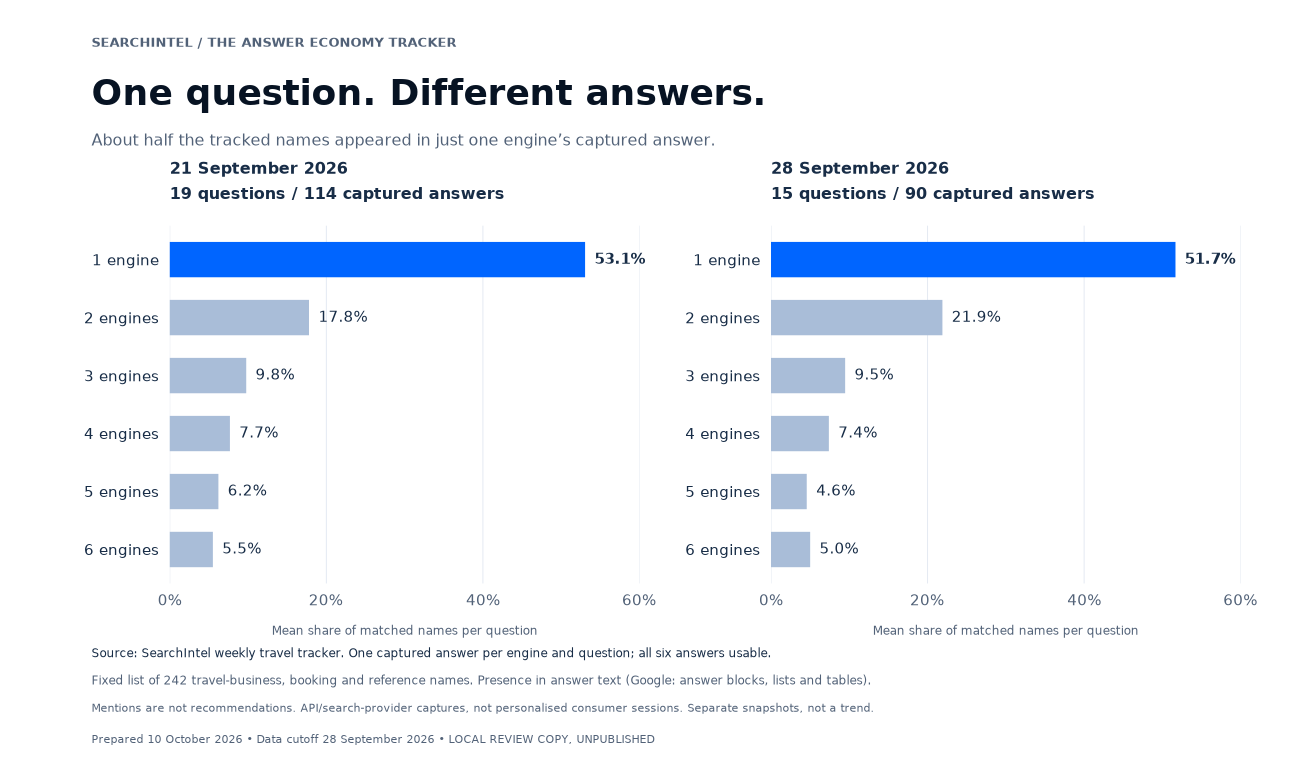
21 September has 19 jointly usable questions (114 answers); 28 September has 15 (90 answers). These 204 answers are a subset of the 742-answer corpus. For each question, take the union of matched names across all six answers. Count how many names appear in exactly one, two, three, four, five or six engines. Divide each bin by that question’s union size, then take the arithmetic mean across questions.
The headline shares are 53.05% and 51.67%, displayed as 53% and 52%. They are separate snapshots under their own collection settings, not a trend. Between the two dates Claude moved from batch to live requests with its answer limit raised from 4,000 to 16,000 tokens, the ChatGPT API limit rose from 4,000 to 16,000 tokens, and Perplexity moved from Sonar Pro on its chat completions API to Sonar on its agent API. Rounded six-bin shares may not sum to 100%.
Question 20 is omitted from the 21 September all-six sample. Questions 3, 4, 6, 19 and 20 are omitted from 28 September. The explorer exposes only jointly usable questions. Different question subsets and engine settings limit comparison between the dates.
The pairwise matrix instead uses every usable pair of engine answers for a question, excluding empty unions. Each cell has its own question denominator. Its statistic is mean intersection divided by union, computed per question before averaging. It is not a measure of recommendation quality.
5. Repeat comparisons
The repeat charts include AI Overviews, AI Mode and Gemini only. Google answers start on 3 August, the first capture with a stored original response. All comparisons between the 16 and 17 August captures are removed because they were collected less than a day apart. Gemini comparisons spanning 7 to 14 September (model change, Gemini 3.5 Flash to 3.6 Flash, and a thinking setting change) and 14 to 21 September (answer limit raised from 2,048 to 4,096 tokens) are also removed. Claude is omitted from repeat charts because its collection route switched between batch and live requests during the period, and its answer limit rose from 4,000 to 16,000 tokens on 28 September. ChatGPT and Perplexity have too little comparable history in the chosen window; their collection settings or service changed between the two September captures.
For retained adjacent archive runs, match the same question within the same engine. Compute the number of names found in both divided by the number found in either. Exclude pairs with empty unions and average the remaining ratios. The published repeat chart uses 336 pairs across three engine services.
| Engine | Retained archive pairs | n | Mean overlap |
|---|---|---|---|
| AI Overviews | W32-W33, W34-W35, W35-W36, W36-W37, W37-W38, W38-W39, W39-W40 | 117 | 48.0% |
| AI Mode | W32-W33, W34-W35, W35-W36, W36-W37, W37-W38, W38-W39, W39-W40 | 139 | 46.5% |
| Gemini | W34-W35, W35-W36, W36-W37, W39-W40 | 80 | 55.3% |
First-name persistence has different denominators. “Mentioned again” requires a matched name in the earlier answer and a usable later answer. “First again” requires at least one matched name in both. The exact numerators, denominators and means are in the downloadable data.
These exclusions do not make the remaining series controlled experiments. Google's settings are not observable or retained, so changes on Google's side between captures cannot be ruled out. Engine answer lengths, windows and completion filters differ. Do not use the chart to rank engines for reliability, or interpret the overlap as a noise floor, randomness, causal effect or prediction of future outcomes.
6. Reproducibility and files
- Aggregate study tables: exact proportions and denominators, in CSV.
- Question distributions: counts in one to six engines, for each jointly usable question.
- The 20-question panel.
- Capture coverage and recorded settings.
- Page data: all numbers used by the interactive explorer.
- Input fingerprint manifest: relative file identifiers and SHA-256 hashes, without source payloads.
- Lead chart, SVG and PNG.
The raw captures, roster and audit scripts remain internal. The public aggregate files let a reader reproduce the displayed summaries and inspect denominators; they do not independently reproduce alias classification from raw text.
Roster SHA-256: 1df7f7a2c9b6ae4a1a9ae93e3c51ac6c447cf53d65bd5e4242d01a48cbd42403. Source files and current input hashes are recorded in the manifest. Headline charts use whole percentages; the downloadable chart and the pairwise detail use one decimal place. CSV and JSON downloads keep greater precision.
7. Commercial disclosure
SearchIntel provides AI search advisory services. Some companies in our dataset are SearchIntel customers. This study uses its independent weekly tracker, with no customer scans or customer analytics. None is identified or singled out. The study supports carefully scoped measurement; it does not establish that SearchIntel services cause visibility improvements or revenue.
8. The fixed question panel
- What's the best tour operator for a first safari in Africa?
- Best companies for small group tours of Europe?
- Who should I book a luxury honeymoon through?
- Best websites to book tours and activities for a city break?
- Is it better to book excursions through a tour company or directly?
- Best UK tour operators for escorted tours?
- Which travel companies are best for solo travellers?
- Best river cruise companies for first-timers?
- Who are the most reliable companies for tailor-made holidays?
- Best family adventure holiday companies?
- What's the best way to book a walking or cycling holiday in Europe?
- Which companies offer the best food tours in major cities?
- Which travel company is best for a multi-centre holiday?
- Who should I book an expedition cruise with?
- Best companies for wildlife holidays?
- Which tour operators have the best sustainability credentials?
- Best luxury travel companies for Asia?
- Is a travel agent worth it compared to booking online?
- Best tour operators for over-50s holidays?
- Which UK holiday companies have the best customer service and financial protection?