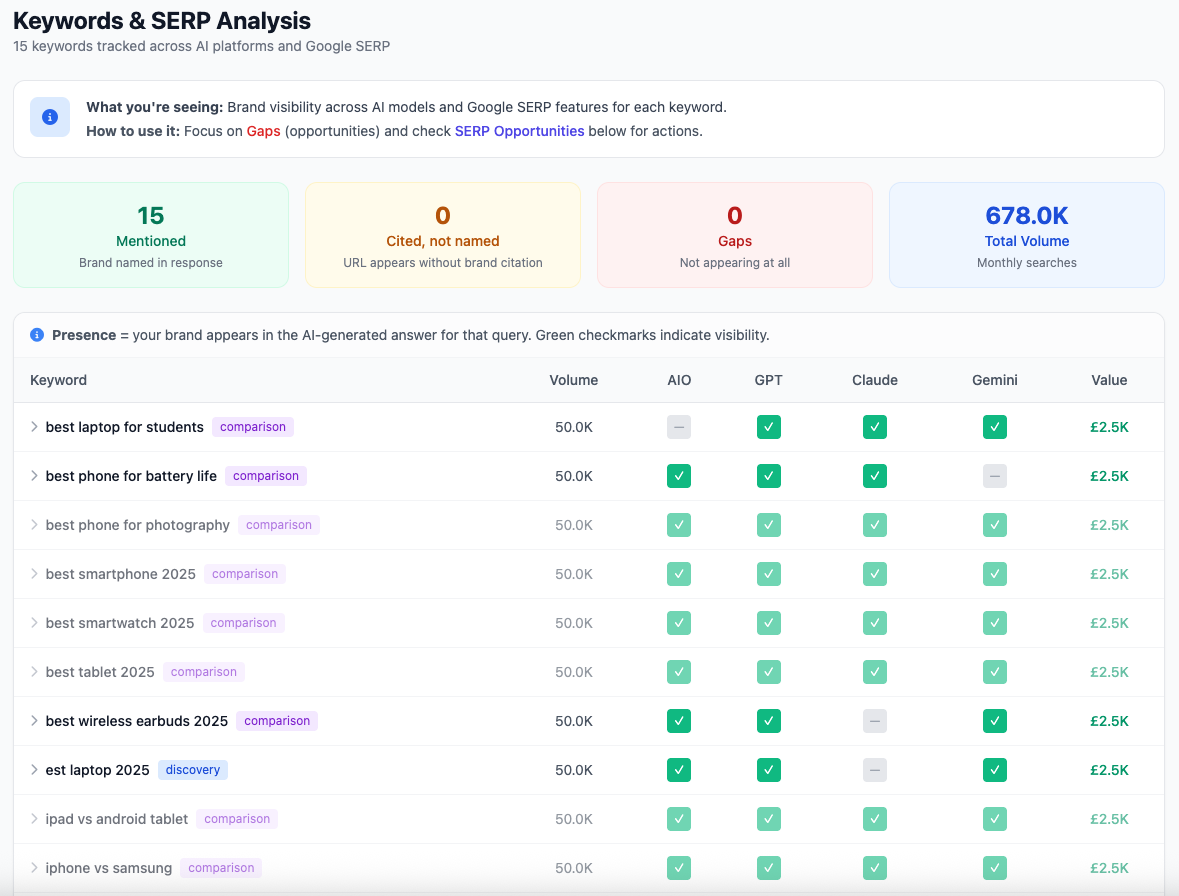
We built proprietary technology to track how brands appear across AI search platforms. Here's how it works.
We track brand visibility across the AI platforms that matter.
The AI answers appearing at the top of Google search results.
The world's most popular AI assistant, used by millions daily.
Anthropic's AI assistant, growing rapidly in business use.
Google's conversational AI, integrated across Google products.
Citation-first AI search engine, exposing source links on every answer.
Google's dedicated conversational search tab, reached 1B MAU at I/O 2026.
We query each AI platform with your target keywords, the same questions your customers are asking.
We record which brands appear, where they rank, what sources are cited, and who your competitors are in each response.
We turn raw data into strategic insights: what's working, what's not, and what to do about it.
One query, once, is not data. It is a snapshot with no context.
Ask the same question twice and you will get two different answers. AI models sample probabilistically and personalise by conversation history. A single manual check tells you nothing about how your brand actually performs across the long tail of sessions your customers will run.
SearchIntel runs every query through ChatGPT, Claude, Gemini, Perplexity, and Google AI Overviews, and repeats each query enough times to stabilise the variance. The output is a distribution, not a single answer. We report how often your brand is recommended versus mentioned versus absent, and which competitors consistently appear in the top of each response.
Visibility is a moving target. A brand that ranks in 40 percent of responses today may fall to 15 percent next month as AI models retrain, competitors publish, or review sentiment shifts. SearchIntel stores every check and shows you the trend, not just the latest reading.
When an AI model names a brand, we capture what it cited. A recommendation backed by a Reddit thread behaves differently from one backed by a review site or a publisher article. Understanding the citation pattern is what makes the data actionable.
We track visibility across six markets with native-language prompts because AI recommendations differ by region.
English
English
German
French
Spanish
English
AI platforms give different answers in different markets. We track them all.
The metrics that matter for AI visibility.
Whether your brand appears in AI responses, and how often.
Which competitors are recommended instead of you.
Where AI platforms get their information from.
Whether you're the top recommendation or a secondary mention.
How often Google shows AI Overviews for your keywords.
How your visibility is changing week to week.
Most AI visibility tools report one number. We report three because they answer different questions.
The percentage of AI queries in your category where your brand appears at all. This is your floor. If you are not in the memory, you are not in the consideration set.
Answers the question: are we even visible?
Of the queries where your brand appears, how often are you actively recommended versus just listed. Being named in a roundup is not the same as being the answer. Pipeline correlates with the second, not the first.
Answers the question: are we the choice?
The signal strength behind the recommendation. AI models weight sources: Reddit threads, review sites, publisher articles, and community forums all contribute differently. Entity Authority captures whether your brand has the citation footprint that AI treats as credible.
Answers the question: will the recommendation hold?
All three move independently. A brand can have high Share of Memory and low Recommendation Rate, which means people see the name but do not choose it. A brand can have high Recommendation Rate and low Entity Authority, which means the recommendation is fragile and vulnerable to the next model retrain. We track all three because any single number misleads.
No one has access to real query data from ChatGPT, Claude, or Gemini. These platforms don't share what users are searching for.
Every AI visibility tool, including ours, uses synthetic prompts to estimate brand presence. The data is directional, not absolute.
What matters is the signal: Are you visible? Are competitors winning? Is it getting better or worse?
We're transparent about this because we think you should know how the data works. We focus on trends, patterns, and actionable insights, not false precision.
Here's an example of what we produce.
Diagnostic engagements cover 50 to 100 queries. Ongoing retainers scale beyond that, typically 200 to 500 queries depending on category breadth and geographic footprint. The query set is co-designed with your team, so it reflects the questions your buyers actually ask.
ChatGPT, Claude, Gemini, Perplexity, and Google AI Overviews. These account for the overwhelming majority of AI search traffic we see in client GA4 data. We add new platforms as their query volume crosses a meaningful threshold.
Core queries run daily for retainer clients. Diagnostic query sets run weekly during the engagement, with a full refresh at week one, three, and six. Historical snapshots are preserved so you can track movement week over week or month over month.
Yes. Retainer clients get monthly reporting in deck format plus a data export on request. Raw query responses are available for any date inside the retention window.
SearchIntel stands alongside your analytics rather than inside it. We read from GA4 and Search Console to correlate AI visibility with downstream traffic and conversion patterns. We do not write data into your systems.
The 45-day diagnostic is the smallest strategic engagement. Ongoing access to the platform is through a three-month strategic advisory retainer. We do not offer self-serve monthly subscriptions because the platform alone does not deliver the outcome most buyers are looking for.
Book a call and we'll walk you through your AI visibility.